- +919059638637,8187864440
- solakrenewablesenergy@gmail.com

On grid Solar Soultions


On grid Solar Soultions
1. What Is an On-Grid Solar System?
On-grid refers to a type of solar system that is tied to the local grid. It is highly recommended for domestic use as household energy needs change, usually per diem. The system is designed to manage electricity when energy output exceeds or falls below your requirement.In this system, the grid acts as your battery bank. When the panels get less sunshine and fail to give standard energy output, you can switch to grid electricity instead of buying a battery. In addition, the on-grid system will automatically transfer excess and unused solar electricity to the grid, allowing you to build credit. These solar credits then can be used to purchase grid electricity, or you can cash them out by the end of the year. This arrangement works under the net metering system.
2.How Does an On-Grid Solar System for Home Work?
Like other types of solar plants, the panel generates electricity in an on-grid solar system. However, since the system is connected to the local grid, the net metering system plays an important role in your monthly electricity cost.
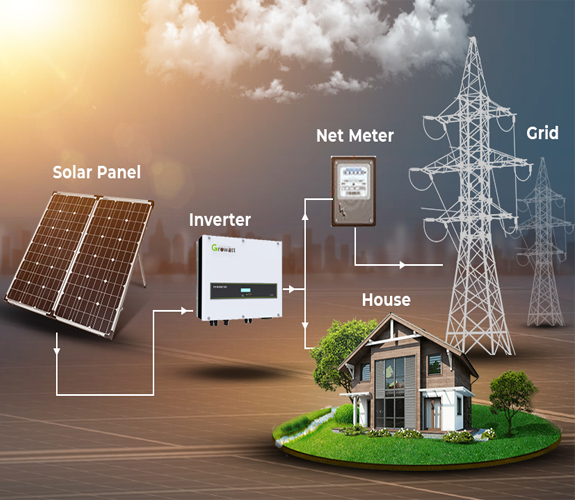
An on-grid solar power system provides your home with the electricity required during sunshine hours. As it is connected to the grid, you can draw power from the battery storage when electricity generation is low — primarily during the night and on cold and cloudy days. The arrangement of solar panels on the roof captures maximum sunlight and converts it into solar power. This energy generated in DC form runs through the inverter to transform into alternating current (AC). This solar electricity is suitable for running your home appliances and all electronic devices.
When the solar energy generated is more than the requirements of your house, the unused power is fed to the national grid. Similarly, you can draw power from the grid when there is insufficient energy production. The meter box records the import and export of power and eventually tells you the net amount to be paid/received through monthly utility bills.
3. Benefits of an On-Grid Solar System
There are plenty of advantages of an on-grid solar system for homeowners beyond the fact that it costs less than other types of solar systems since fewer components are needed. Also, the financial benefits of solar for homes outweigh the cost of PV systems over time, not to mention the incredible environmental benefits solar offers.
- Constant supply of power
A grid-connected solar system guarantees that your home always gets power, even when your solar system is undergoing repair or generates insufficient power on rainy and cloudy days. You can also opt for a battery bank when personalising your system to store some surplus energy to be used when the grid is down. As a result, you are not entirely dependent on the sun and can draw any additional energy, when needed, from the grid.
- Energy Cost Savings
With solar powering your home, your monthly energy bill plummets, giving you the joy of small savings. These small portions add up to show significant savings. Additionally, solar investment also promises high returns. Every month you use solar electricity and don’t purchase any grid electricity, your bill will reflect a nominal charge. On days when your panels generate excess electricity, you can export it to the government grid for credit units, which will also reflect in your monthly utility bills. When your electricity exports exceed your imports, you will be paid at tariff rates fixed by the government. Your solar system not only reduces your electricity cost but also becomes a source of your income. These savings accumulate into a large amount over the years, just as enough even offset your initial solar cost in just 6-8 years.
- Generate your own electricity
When you live in a solar-equipped home, you are nearly grid-independent and can generate the amount of electricity you need to function every day. Your solar company ensures that you get the right capacity of an on-grid solar system based on your electricity needs so that the days when you get to switch to the government grid are as few as possible. Moreover, today’s photovoltaic solar panels are more energy-efficient and give higher energy output against the amount of sunshine captured by each solar cell. As a result, less area and few panels are needed to meet your electricity requirements.
- Environmentally-friendly
The environmental benefits of solar are a major reason why you should get rooftop solar and why the government is offering subsidies to make on-grid solar power systems more affordable for homes. By adopting solar, you reduce greenhouse gas emissions, lower the demand for fossil fuels, and eventually decrease your own carbon footprint.
4.Facts About On-Grid Solar Power Systems
Know more about what an on-grid solar system is and how you can benefit from it:
The primary 1 kW capacity solar system can generate an average of 4 units a day, which means 120 units a month – amounting to 1,440 units throughout a year.
In an on-grid solar system, the components are covered under product warranties. The solar arrays mounted on your roof will have 25 years of performance warranty. Other components like the inverter and batteries will have 5-10 years of warranty, depending on the manufacturer.
Several solar companies also provide exhaustive maintenance services under the solar AMC package to help homeowners maintain their solar systems throughout their 25 years of lifespan.
The benefits of net metering will apply to this type of solar system, meaning you will be able to draw energy from and transfer energy to the local grid.
The MNRE allows residential solar buyers to purchase their on-grid solar system from any vendor of their choice and get a 40% subsidy on the grid-connected solar system of up to 3kW capacity.